
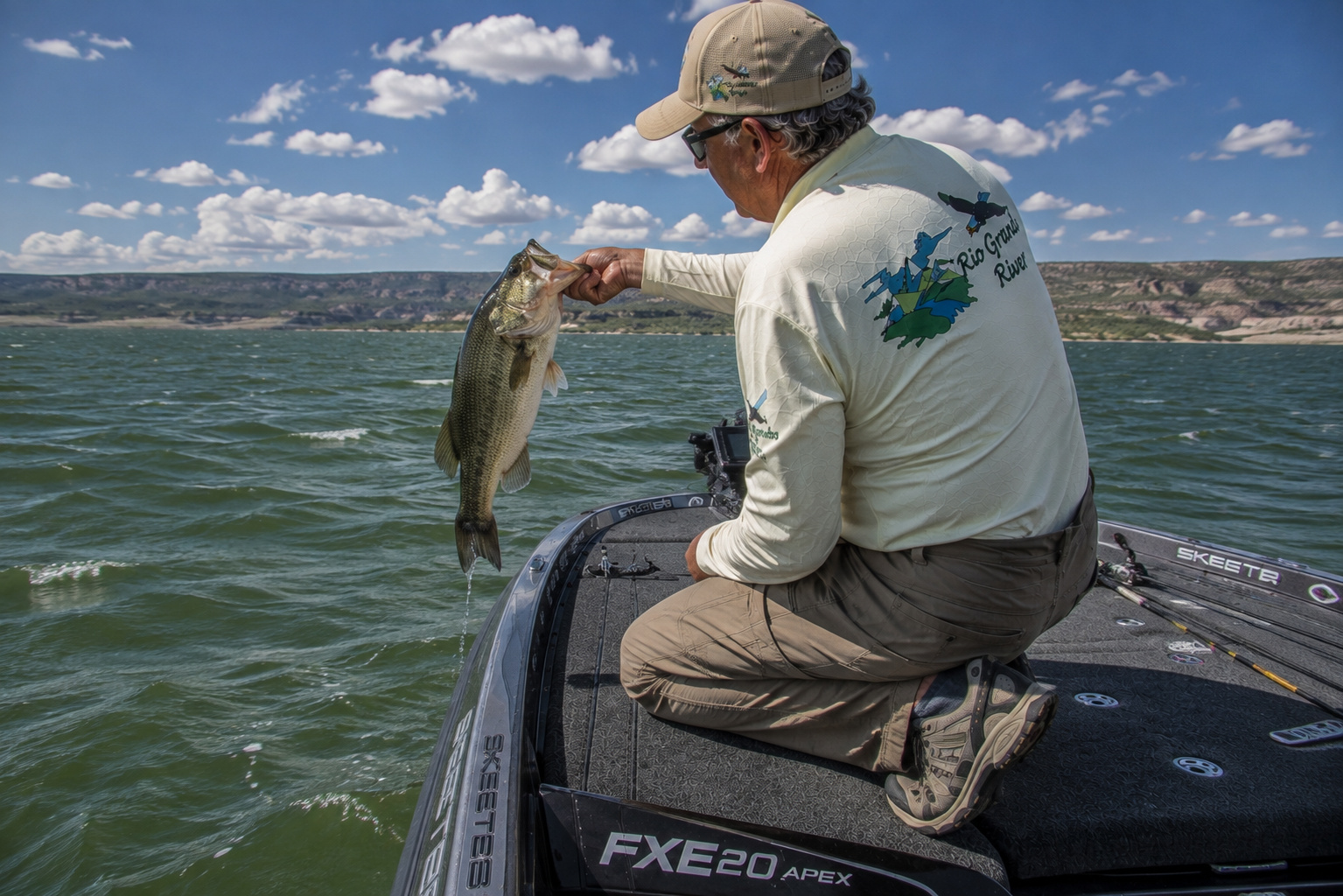
Rio Grande River Del Rio to Lake Falcon Texas: Following the Border to a Legendary Bass Lake
There are certain Texas lakes whose names will make an old bass fisherman look up from whatever he is doing.
Falcon is one of them.
For decades, Falcon Lake has carried an almost mythical reputation among Texas bass anglers. There have been years when tournament sacks coming out of Falcon sounded less like fishing reports and more like typographical errors.
Five bass.
Thirty pounds.
Sometimes more.
I spent a good many years guiding and tournament fishing Texas reservoirs, and I've learned that lakes have personalities. Some are dependable. Some are temperamental. Some give up their secrets readily, while others make you earn every bite.
Falcon has always struck me as a lake with a little swagger.
But before we reach it, our journey down the Rio Grande River has several hundred fascinating miles yet to travel.
We begin near Del Rio, where the Rio Grande emerges from Amistad Reservoir. From there it bends southeast through increasingly remote South Texas ranch country, passes Eagle Pass and Laredo, and eventually backs into the sprawling waters of Falcon International Reservoir near Zapata.
By now this is a very different Rio Grande from the river Paulette and I knew farther north.
There are no snow-covered peaks.
No alpine meadows.
No trout sipping mayflies beneath willows.
This is South Texas.
Mesquite.
Blackbrush.
Prickly pear.
Guajillo.
Cenizo.
White-tailed deer.
Javelina.
Roadrunners.
Wild turkey.
And summer heat with enough authority to settle most arguments before breakfast.
Yet the water flowing through it is part of the same remarkable river we have followed all the way from the San Juan Mountains of Colorado.
That's what keeps drawing me downstream.
So let's launch another chapter.
We're leaving Del Rio and following the Rio Grande River to Falcon Lake.
Leaving Del Rio and Amistad Behind
Our previous chapter brought us from Langtry past the confluence of the Pecos River and into Amistad Reservoir, where the Rio Grande, Pecos and Devils River combine to form one of the great fishing lakes of the Southwest.
If you're joining this journey here, my article on primary water sources for the Rio Grande River watershed provides useful background on the tributaries, snowmelt, rainfall and other sources that keep this enormous river system alive. (Rio Grande River)
Below Amistad Dam, the Rio Grande becomes a river again.
And immediately, water management matters.
This is not simply a wild river responding to rainfall somewhere upstream. Amistad stores water for flood control, irrigation, hydroelectric generation and international obligations. Releases affect downstream flow, and the Rio Grande increasingly becomes both a natural river and a working piece of international water infrastructure.
Yet step away from the dams and cities and much of the country remains surprisingly empty.
The river winds through ranchlands where public roads may be miles away.
Mexico remains immediately across the water.
And the landscape begins its long transition from the Chihuahuan Desert toward the thornscrub country of South Texas.
A River Between Two Nations
From El Paso onward, the Rio Grande serves as the international boundary between Texas and Mexico.
Here below Del Rio, that fact becomes inseparable from the geography.
The river bends.
The border bends with it.
Cottonwoods, willows and cane mark portions of the floodplain. Away from the water, the vegetation becomes increasingly thorny and drought adapted.
The farther southeast we travel, the warmer the climate becomes.
By the time we reach Zapata and Falcon Lake, we've entered country where winters can be remarkably mild and summers can become downright formidable.
To me, that transformation is part of the beauty of following the river from beginning to end.
Our Rio Grande Reservoir near Creede, Colorado sat among high mountains and trout water. Here we are heading toward an 84,000-acre bass lake surrounded by South Texas brush. (Rio Grande River)
Same river.
Different universe.
Eagle Pass and the Middle Rio Grande
Following the river downstream brings us toward Eagle Pass, Texas, opposite Piedras Negras, Coahuila.
This has been a crossing place for generations.
Long before bridges, highways and modern cities, the river influenced where people traveled, settled and traded.
That has been one of the recurring themes of this entire Rio Grande journey.
People follow water.
Wildlife follows water.
Roads eventually follow people.
And towns grow where all three meet.
The Rio Grande corridor here supports riparian habitat surrounded by country considerably drier than the riverbanks themselves.
For a wildlife photographer, those green ribbons deserve attention.
White-tailed deer move through the brush.
Javelina travel in family groups.
Coyotes are common.
Bobcats inhabit the thornscrub.
Wild turkey occur in suitable habitat.
Raptors patrol the sky.
Roadrunners hunt along the ground.
And as we continue south, bird diversity becomes increasingly interesting because subtropical species begin mixing with familiar Texas birds.
I've spent enough years behind a camera to know that ecotones, places where one habitat begins blending into another, can be tremendously productive.
South Texas is full of them.
Laredo and the Rio Grande River
Continue downstream and we reach Laredo, opposite Nuevo Laredo, Tamaulipas.
The Rio Grande here flows through one of the busiest international trade corridors in North America.
That's quite a contrast from Big Bend.
Not terribly far upstream in geographical terms, Paulette and I could have been standing on a canyon rim looking down upon miles of river with hardly another human being visible.
Here the river passes between two large cities.
That's the Rio Grande again.
It refuses to be one thing for very long.
Above Laredo, tributaries and arroyos contribute intermittently from both sides of the border. Below Laredo, the river continues southeast toward Falcon.
Rainfall becomes increasingly important.
Unlike the snowmelt-dominated upper watershed, South Texas receives substantial portions of its useful inflow from thunderstorms, tropical moisture and occasional major storm events.
A dry creek can remain insignificant for months and then suddenly send tremendous runoff toward the Rio Grande.
That variability eventually becomes one of the defining characteristics of Falcon Lake.
Following the Rio Grande Toward Zapata
South of Laredo, U.S. Highway 83 becomes our principal road companion.
The Rio Grande remains to the west, sometimes nearby and sometimes hidden beyond private ranchlands.
This is genuine South Texas brush country.
I have always enjoyed this landscape.
At first glance, somebody accustomed to mountain forests might call it empty.
Spend time there and it becomes anything but empty.
The brush is alive.
Cenizo can explode with purple flowers after rain.
Prickly pear blooms.
Mesquite provides shade and seed pods.
Whitetails slip through openings at dawn and dusk.
Quail disappear into cover with astonishing efficiency.
Raptors use fence posts as hunting perches.
And somewhere beyond that thorny horizon lies the Rio Grande.
Then the country begins opening toward Zapata.
And eventually you see water.
A lot of water.
Or, depending upon the year, considerably less water than the old shoreline suggests.
Welcome to Falcon.
Falcon International Reservoir
Falcon International Reservoir, commonly called Falcon Lake, was impounded in 1954 on the Rio Grande.
Texas Parks and Wildlife lists its full-pool surface area at 83,654 acres, with a maximum depth of approximately 110 feet near Falcon Dam. Conservation pool elevation is 301.2 feet above mean sea level. (Texas Parks & Wildlife)
Falcon straddles the United States-Mexico border.
Texas lies on the eastern shore.
Tamaulipas lies on the western shore.
The International Boundary and Water Commission controls the reservoir. (Texas Parks & Wildlife)
At full pool, this is a huge lake.
And even at today's reduced level, Falcon remains a substantial piece of water.
Falcon Lake Water Level in 2026
This is where anyone planning a trip needs current information rather than memories of what Falcon looked like fifteen years ago.
Falcon is notorious for water-level fluctuations.
TPWD describes them as severe, commonly 40 to 50 feet or more. (Texas Parks & Wildlife)
As of early August 2026, Water Data for Texas reported Falcon at approximately 264.6 feet elevation, about 36.6 feet below conservation pool and approximately 26 percent full on the Texas conservation-storage basis. The reservoir's surface area was around 31,800 acres. (Water Data For Texas)
Interestingly, that is a considerable improvement over a year earlier, when the lake was around 16 percent full. (Water Data For Texas)
Low water completely rearranges the fishing map.
Points become longer.
Creek channels become more obvious.
Old roads emerge.
Formerly submerged trees stand high and dry.
Boat ramps become unusable.
And areas where I might once have fished a spinnerbait can become suitable places to park a pickup.
That means an angler needs to fish the Falcon that exists today, not the Falcon he remembers from a tournament television show.
Rivers and Creeks Feeding Falcon Lake
The Rio Grande River is the principal river feeding Falcon.
On the Mexican side, several drainages contribute water, most importantly the Río Salado, which enters the Rio Grande system in the Falcon region and drains a substantial watershed in northeastern Mexico.
Numerous smaller creeks and arroyos enter from both Texas and Mexico.
On the Texas side, creek arms and named coves become especially important to fishermen because they create the kind of habitat largemouth bass love:
channels,
points,
flats,
brush,
timber,
and transitions between shallow and deep water.
During wet years, flooded terrestrial vegetation can transform Falcon.
During drought, much of that habitat disappears.
Falcon Lake Habitat and Structure
Falcon has never been a lake where I would simply put the trolling motor down and fish every visible foot of shoreline.
There is too much water.
I want something specific.
TPWD describes aquatic vegetation as sparse hydrilla, but that doesn't tell the whole habitat story. (Texas Parks & Wildlife)
A TPWD fisheries survey found that during prolonged low-water conditions, flooded terrestrial vegetation covered only about 8 percent of available habitat. The same report emphasized that Falcon's habitat quality changes dramatically with reservoir elevation. (Texas Parks & Wildlife)
At favorable water levels, newly flooded brush can become tremendous bass habitat.
At low water, structure assumes greater importance.
I would concentrate on:
main-river channel edges
creek channels
secondary points
long tapering points
rocky ledges
submerged timber
old roadbeds
humps
channel bends
brush lines
rock-to-mud transitions
and whatever aquatic vegetation remains submerged.
Falcon bass have plenty of places to hide.
The trick is finding the places where hiding and feeding happen at the same address.
Fish Species in Falcon Lake
Texas Parks and Wildlife lists largemouth bass and channel catfish as Falcon's predominant sport species. (Texas Parks & Wildlife)
The broader fish community also includes:
-
largemouth bass
-
blue catfish
-
channel catfish
-
flathead catfish
-
black crappie
-
white bass
-
bluegill and other sunfish
-
gizzard and threadfin shad
-
Rio Grande cichlid
-
carp
-
buffalo
-
gar
-
tilapia
Falcon has developed a particularly strong reputation for trophy catfish in recent years. TPWD's early 2026 reports documented 25- to 50-pound-class catfish being caught around river-channel structure. (Texas Parks & Wildlife)
And a 75.8-pound blue catfish became the Falcon water-body record on January 3, 2026. (Texas Parks & Wildlife)
That's enough catfish to require a landing plan.
But bass are what made Falcon famous.
An Important Word About Smallmouth Bass
You asked me to cover both largemouth and smallmouth bass month by month, but accuracy matters more than filling a heading.
Falcon is not a recognized smallmouth bass fishery in current TPWD information.
TPWD's Falcon fishery page identifies largemouth bass as the reservoir's black-bass sport fish, its recent management surveys concentrate on largemouth bass, and the current Falcon water-body records do not list a smallmouth bass record. (Texas Parks & Wildlife)
So I would not tell a reader to travel to Falcon specifically for smallmouth.
That would be sending him hunting elk in a shrimp boat.
This month-by-month guide therefore concentrates on largemouth bass, which is Falcon's legitimate and historically important bass fishery.
Falcon Lake Largemouth Bass Fishing
Falcon's reputation was built on big largemouth.
TPWD's fisheries work shows just how important bass fishing is here. In its 2022 creel survey, 73.5 percent of all fishing effort on Falcon targeted largemouth bass, and 18 percent of released largemouth bass weighed more than four pounds. (Texas Parks & Wildlife)
Florida-strain largemouth bass have been stocked repeatedly to maintain trophy genetics. (Texas Parks & Wildlife)
And the lake record tells the rest of the story.
Falcon Lake Largemouth Bass Record
The current TPWD Falcon Lake record largemouth is:
15.63 pounds
28 inches long
Caught January 7, 2011
Angler: Tommy Law
Lure: Zoom Magnum Fluke. (Texas Parks & Wildlife)
Fifteen pounds and ten ounces.
On a soft plastic.
That will make you inspect your knot twice.
My Basic Falcon Bass Tackle
If I were loading my Skeeter for Falcon, I wouldn't arrive with dainty equipment.
There is too much wood.
Too much brush.
And too much possibility that the next bite will have shoulders.
For general casting, I want a 7-foot to 7-foot-3-inch medium-heavy baitcasting rod with a quality reel in roughly the 6.3:1 to 7.3:1 range.
For pitching heavy cover, I'd step up to a 7-foot-3-inch to 7-foot-6-inch heavy rod.
For crankbaits, a 7-foot medium-heavy moderate-action rod provides the flex I want with treble hooks.
And I would still carry a 7-foot medium spinning rod with a 2500-size reel for finesse work.
Fishing Line
My basic choices would be:
12- to 15-pound fluorocarbon for many open-water presentations.
15- to 20-pound fluorocarbon around heavier cover.
30- to 50-pound braid around dense brush or vegetation.
8- to 10-pound fluorocarbon for finesse spinning presentations where water clarity permits.
Falcon's water ranges from turbid in the upper reservoir to stained farther downlake. (Texas Parks & Wildlife)
This is not usually gin-clear Amistad.
I can get away with stronger line.
And when a six-pound bass wraps itself around a submerged mesquite tree, stronger line suddenly seems like excellent financial planning.
My Falcon Lake Lure Box
I would bring:
½- and ¾-ounce spinnerbaits
3/8- to ¾-ounce bladed jigs
squarebill crankbaits
medium and deep-diving crankbaits
lipless crankbaits
½- to 1-ounce football jigs
flipping jigs
6- to 10-inch Texas-rigged worms
creature baits
craws
5- to 7-inch soft jerkbaits
paddle-tail swimbaits
Carolina rigs
topwater walkers
poppers
buzzbaits
and a handful of finesse plastics for those occasions when Falcon decides to become civilized.
Falcon Lure Colors
In stained water:
black and blue
junebug
plum
red shad
chartreuse and white
firetiger
dark crawfish
In clearer lower-lake water:
green pumpkin
watermelon red
natural shad
white
pearl
brown crawfish
Now let's fish Falcon through an entire year.
Falcon Lake Bass Fishing Month by Month
January: Trophy Time
January deserves respect.
Remember that Falcon's 15.63-pound lake record was caught January 7. (Texas Parks & Wildlife)
TPWD's January 2026 reports showed water temperatures generally in the mid-50s to low 60s as fronts passed through. (Texas Parks & Wildlife)
Largemouth will often stage around:
channel edges,
deep timber,
rocky points,
creek mouths,
and nearby flats.
I would work 8 to 25 feet, occasionally deeper.
Try a ½-ounce football jig, 6- to 8-inch Texas-rigged worm, suspending jerkbait, slow-rolled spinnerbait or soft-plastic fluke.
Fish deliberately.
Cold water is not an invitation to see how quickly you can retrieve a lure.
February: Prespawn Movement
February begins pushing bass toward spawning country.
Cold fronts may knock them back toward deeper structure, while several warm sunny days can pull fish remarkably shallow.
Fish creek-channel intersections and the first major points leading into spawning pockets.
Depths from 5 to 20 feet are productive starting points.
Use:
lipless crankbaits,
squarebills,
spinnerbaits,
Texas-rigged creature baits,
jigs,
and 5- to 7-inch soft jerkbaits.
Red and crawfish colors deserve attention.
March: The Shallow-Water Show
March can be magnificent.
Water warms.
Bass move shallow.
Protected pockets, flats, creek arms and flooded brush become increasingly important where water levels provide suitable habitat.
Start in 2 to 10 feet.
Pitch a 4- to 6-inch creature bait into brush.
Work spinnerbaits around timber.
Run squarebills into cover.
Throw a soft jerkbait around shallow points.
And if conditions are right, tie on a buzzbait.
South Texas bass don't read calendars.
Sometimes spring arrives early.
April: Spawn and Postspawn
April often finds fish in several phases at once.
Some are spawning.
Some are guarding fry.
Others are already moving away from shallow bedding areas.
This is when I work from the backs of pockets outward.
Start shallow.
Then fish secondary points and channel edges.
A 5- to 7-inch Texas-rigged worm, creature bait, weightless soft plastic or swim jig can be excellent.
Topwaters become increasingly useful during low light.
Handle spawning fish carefully and return them quickly.
A big female Falcon bass is far more valuable swimming than decorating somebody's freezer.
May: Feeding and Transition
By May, bass increasingly follow forage.
Shad become important.
Early mornings can produce exciting topwater fishing.
Try:
walking baits,
buzzbaits,
spinnerbaits,
swimbaits,
and squarebills.
As the sun rises, move toward 8 to 20 feet with Carolina rigs, crankbaits and Texas-rigged worms.
Long points touching channel water are particularly interesting.
June: Summer Arrives
June begins the serious heat.
Launch early.
I would start with topwaters along shallow structure and then transition toward deeper points, ledges and channel bends.
Fish from 5 feet early to 20-plus feet later.
Deep crankbaits, 8- to 10-inch worms, Carolina rigs and football jigs become important.
Watch your electronics.
A beautiful-looking point without baitfish is still just geology.
July: Deep Structure and Shade
July is when South Texas reminds you who owns the thermostat.
Fish first light.
Bass may feed shallow around dawn but increasingly relate to deeper structure as sunlight climbs.
Look for 15 to 30 feet along:
river-channel bends,
creek-channel ledges,
deep timber,
points,
and humps.
Try deep crankbaits, Carolina rigs, football jigs and big worms.
Black-and-blue or plum plastics can be excellent in stained water.
August: Fish Early and Fish Smart
August is not the month to demonstrate your endurance.
It's the month to demonstrate your alarm clock.
Be on the water before sunrise.
Topwater activity may occur around shad early.
Then move deeper.
Deep-diving crankbaits, heavy Texas rigs, Carolina rigs and jigs should be ready.
If the lake develops a thermocline, pay attention to where bait and bass concentrate vertically rather than automatically fishing the deepest structure available.
And drink water.
Lots of it.
September: Watching for Change
September still feels like summer, but the days are shortening.
Shad begin influencing bass movements more noticeably.
Look for schooling activity near:
points,
creek mouths,
channel edges,
and flats adjacent to deeper water.
Use walking topwaters, lipless crankbaits, spinnerbaits and paddle-tail swimbaits.
If fish are scattered, cover water.
This is not always the month for marrying one stump.
October: Fall Feeding
October is one of my favorite months on a Texas bass lake.
Temperatures moderate.
Shad move.
Bass become more active.
Fish creek arms and secondary points.
A squarebill bounced through shallow cover can be deadly.
So can a spinnerbait around flooded brush.
Try 3 to 15 feet before moving deeper.
White, chartreuse-white and natural shad patterns are strong choices.
And keep a topwater handy all day when clouds and wind cooperate.
November: Follow the Bait
November can provide some of Falcon's most pleasant fishing weather.
Bass often follow shad toward creek arms and protected pockets.
Rock and timber both deserve attention.
Use:
medium-diving crankbaits,
spinnerbaits,
jigs,
Texas-rigged worms,
and swimbaits.
Cooling water may produce aggressive feeding before winter.
I especially like channel bends with nearby shallow flats.
That's a dining room with a hallway leading directly to the basement.
December: Big-Fish Country
December brings us back toward trophy season.
Cold fronts begin pushing fish between shallow feeding areas and deeper holding structure.
I would concentrate on 8 to 25 feet, adjusting according to weather.
Jigs, soft jerkbaits, deep crankbaits, Texas rigs and slow-rolled spinnerbaits can all produce.
Warm afternoons after several stable days can move surprisingly large bass shallow.
Remember that Falcon's lake record came only a week into January.
The fish that becomes next January's trophy is already swimming there in December.
Productive Water Temperatures for Falcon Bass
Rather than treating temperature as a magic number, I use it to interpret seasonal movement.
Below 55°F: slow down and concentrate on deeper structure.
55 to 60°F: prespawn activity increases.
60 to 68°F: excellent prespawn and spawning conditions.
68 to 75°F: spawn, postspawn and strong feeding activity.
75 to 85°F: summer patterns dominate, with early and late shallow feeding.
Above 85°F: concentrate heavily on dawn, dusk, shade, current and deeper structure.
A sudden temperature change often matters more than the absolute number.
A stable 58°F can fish better than a rapidly falling 65°F.
Bass dislike unpleasant surprises about as much as fishermen do.
Best Time of Day
During winter, midday and afternoon warming can improve fishing.
During spring and fall, productive fishing can occur throughout the day.
During summer, I want to be casting at sunrise.
Actually, I want to be casting before sunrise.
The first two or three hours can be dramatically better than midday.
Clouds and wind can extend shallow feeding.
On calm, bright days, expect bass to retreat toward cover and deeper structure sooner.
Falcon Lake Boat Ramps and Public Access
Low water currently complicates access considerably.
Arroyo Veleno Ramp
Location: Off U.S. 83 approximately one mile south of the Arroyo Veleno bridge, Zapata, TX 78076
Operator: Zapata County
Fee: None
Phone for local information: Zapata County Chamber of Commerce, 800-292-5253
Website: TPWD Falcon Reservoir access information
TPWD lists the ramp as accommodating all boat types under normal conditions and being open year-round. (Texas Parks & Wildlife)
At severely reduced lake elevations, however, conditions should be verified locally before towing a boat.
Falcon State Park Boat Ramp
Address: 146 Park Road 46, Falcon Heights, TX 78545
Phone: 956-848-5327
Email: No public park-specific email located
Website: Texas Parks and Wildlife Department
TPWD normally lists a developed boat ramp, courtesy dock, parking, restrooms, fish-cleaning facilities, picnic areas and camping. (Texas Parks & Wildlife)
But here's the important 2026 reality:
Falcon State Park's developed boat ramp is currently closed because of low lake levels. Shore launching is permitted where conditions allow. (Texas Parks & Wildlife)
Check conditions before leaving home.
Falcon Lake County Park
Location: Falcon Lake Park, Falcon Heights area, TX 78545
Phone: 956-848-5327
At lower elevations, normal ramp use can become impossible and launching may be restricted to suitable shoreline. (Falcon Lake Guide)
For a modern fiberglass bass boat, "shore launch" is a phrase I investigate carefully before backing toward the water.
Falcon Lake Tackle and Local Fishing Information
Address: 2825 S. U.S. Highway 83, Zapata, TX 78076
Phone: 956-765-4866
Email: James@FalconLakeTackle.com
This is one of the most useful local stops for tackle, marine supplies and current lake information. (Tackle and Rods)
A good local tackle shop has always been worth visiting before fishing unfamiliar water.
Electronics can show you what's beneath the boat.
A fisherman who's been on the lake all week can tell you why it matters.
Camping at Falcon State Park
Falcon State Park provides one of the most convenient bases for exploring the lower reservoir.
The park offers campsites, screened shelters and cabins, along with hiking, birding, fishing and boating opportunities. Campsites range from water-only sites to water-and-electric and full-hookup RV sites. (Texas Parks & Wildlife)
The mild winter climate makes Falcon especially attractive to winter visitors.
Summer is another matter.
Shade becomes precious.
Air conditioning becomes a respected member of the family.
And nobody needs to explain why fishermen launch before daylight.
Lodging Around Falcon Lake and Zapata
Holiday Inn Express & Suites Zapata
Holiday Inn Express & Suites Zapata
Address: 167 S. U.S. Highway 83, Zapata, TX 78076
Phone: 956-765-1333
Email: holidayzapata@ogihotels.com
The hotel offers complimentary parking, breakfast and an outdoor pool. (IHG Hotels & Resorts)
For anglers, the location in Zapata makes it convenient to restaurants, fuel, tackle and northern/mid-lake access.
Falcon Lake RV Park
Address: 192 Madison Ave., Zapata, TX 78076
Phone: 956-744-4629
Email: No verified public email located
Website: FalconLakeRVPark.com
The park caters to RV travelers and is located close to Falcon Lake. (MyZapata)
I have deliberately omitted email addresses wherever I could not verify one rather than filling the space with guesswork.
When you're writing a fishing guide people may actually use on the road, accuracy beats completeness.
Weather at Falcon Lake
Winter: December Through February
This is one of Falcon's finest seasons.
Days can be wonderfully mild.
Cold fronts still arrive, occasionally dropping temperatures dramatically, but South Texas winters generally provide much more comfortable fishing than summer.
Bass enter prespawn patterns early.
January and February deserve serious attention from trophy hunters.
Spring: March Through May
Spring is prime time.
Bass move shallow.
Vegetation responds to warming weather.
Brush country blooms.
Bird activity increases.
Wind can become a major boating consideration.
This would be my first choice for someone making a once-a-year Falcon bass trip.
Summer: June Through September
Summer is hot.
Not "wear a lighter shirt" hot.
South Texas hot.
Afternoon temperatures commonly reach the upper 90s and can exceed 100°F.
Fish early.
Carry water.
Wear sun protection.
Watch for thunderstorms.
And remember that large open reservoirs can become rough remarkably quickly.
Fall: October and November
Fall brings relief.
Temperatures moderate.
Shad movements stimulate bass activity.
Migratory birds begin appearing.
Fishing pressure can be lighter.
October and November can be wonderful months to combine fishing, wildlife photography and camping.
Wildlife Around Falcon Lake
Falcon lies in one of the most biologically interesting portions of Texas.
This is South Texas brush country approaching the subtropical Lower Rio Grande Valley.
Around the lake and surrounding ranchlands I would watch for:
white-tailed deer
javelina
coyote
bobcat
gray fox
raccoon
armadillo
cottontail
jackrabbit
wild turkey
northern bobwhite
white-winged dove
mourning dove
greater roadrunner
green jay
great kiskadee
caracara
osprey
great blue heron
egrets
and a tremendous variety of migratory birds.
Falcon State Park specifically promotes birding along both the lakeshore and brush-country habitats. (Texas Parks & Wildlife)
For Paulette and me, this is exactly the sort of place where fishing and photography would begin competing for the same sunrise.
I know from experience which one usually wins.
Whichever subject appears first.
Driving to Falcon Lake
Zapata is the primary community for anglers fishing the middle and upper portions of Falcon.
Approximate highway distances vary according to starting point, but these are useful planning figures.
From San Antonio: approximately 210 to 225 miles, generally 3½ to 4 hours. Take I-35 south toward Laredo, then U.S. 83 south to Zapata.
From Austin: approximately 285 to 300 miles, roughly 4½ to 5 hours. Travel south through San Antonio, then I-35 toward Laredo and U.S. 83 south.
From Corpus Christi: approximately 150 to 175 miles, around 2½ to 3 hours, depending upon route. Travel west through South Texas toward Zapata.
From Houston: approximately 350 to 375 miles, roughly 5½ to 6½ hours. A practical route runs southwest through South Texas toward Laredo/Zapata.
From Dallas: approximately 480 to 510 miles, around 7½ to 8½ hours. Travel south through central Texas toward San Antonio and Laredo, then U.S. 83 south.
From Fort Worth: approximately 460 to 490 miles, roughly 7 to 8 hours, generally south toward San Antonio before continuing through Laredo.
For anyone towing a bass boat, I would add time.
Fuel stops take longer.
Meals take longer.
And there is always one fellow at a gas station who sees the Skeeter and wants to tell you about the ten-pounder he caught in 1987.
I consider that part of the trip.
Boating Falcon Lake Safely
Falcon deserves respect.
Low water creates hazards.
Submerged timber can sit just below the surface.
Old roads and structures become shallower.
Long points extend farther into the lake than expected.
Wind can produce rough water.
Use updated mapping.
Watch your sonar.
Slow down in unfamiliar water.
Wear a PFD while running.
Attach the engine cutoff switch.
Carry emergency equipment.
Keep plenty of fuel aboard.
And tell someone where you're going.
Because Falcon is an international reservoir, anglers crossing into Mexican waters should also understand licensing requirements. TPWD notes that everyone fishing Mexican waters must possess the appropriate Mexican fishing license. (Texas Parks & Wildlife)
Stay aware of your location.
A GPS map is considerably more useful than saying, "I think we're still in Texas."
Five Natural Internal Links for the Rio Grande Journey
As this series grows, I would connect this Falcon chapter naturally to five earlier articles:
Primary Water Sources for the Rio Grande River Watershed for the hydrology behind the river. (Rio Grande River)
Rio Grande Reservoir Fly Fishing Creede Colorado to contrast Falcon with the upper river. (Rio Grande River)
Hiking the Upper Rio Grande River as another look at the river's mountain beginnings. (Rio Grande River)
Rio Grande River Wagon Wheel Gap to lead readers back upstream through Colorado. (Rio Grande River)
And Rio Grande River Highway 142 Bridge for the San Luis Valley chapter of the river's journey. (Rio Grande River)
Those links give someone discovering the website through a Falcon Lake bass search a natural path backward toward the headwaters.
One More Sunrise on the Rio Grande River
If I were choosing the photograph for the end of this chapter, I already know what it would look like.
The Skeeter is floating quietly somewhere off a Falcon Lake point.
It is October.
We launched in darkness.
Paulette has coffee.
I have considerably too many rods lying across the front deck, which is something fishermen call "being prepared" and wives sometimes describe differently.
The eastern horizon is beginning to brighten.
A light wind ripples the water.
Somewhere along the Mexican shoreline, a dog barks.
A great blue heron lifts from a dead tree.
I lower the trolling motor.
The graph shows the creek channel sweeping beneath the boat.
Twenty-two feet.
Then fourteen.
Then eight.
There are shad along the edge.
That's enough information for me.
I pick up a spinnerbait.
White and chartreuse.
Half ounce.
Old-fashioned perhaps.
I don't mind.
I've caught an awful lot of bass on lures that were supposed to have become obsolete.
I make a long cast across the point.
Nothing.
Another.
Nothing.
On the third cast the spinnerbait ticks a submerged limb.
I let it fall.
The rod loads.
Not a tap.
Not a peck.
Just weight.
Then the weight starts moving.
I set the hook.
The fish immediately heads toward the timber.
For the next several seconds, everything becomes wonderfully uncomplicated.
No website.
No camera.
No appointments.
No years.
Just fisherman, rod and fish.
She comes up near the boat and rolls.
Big bass.
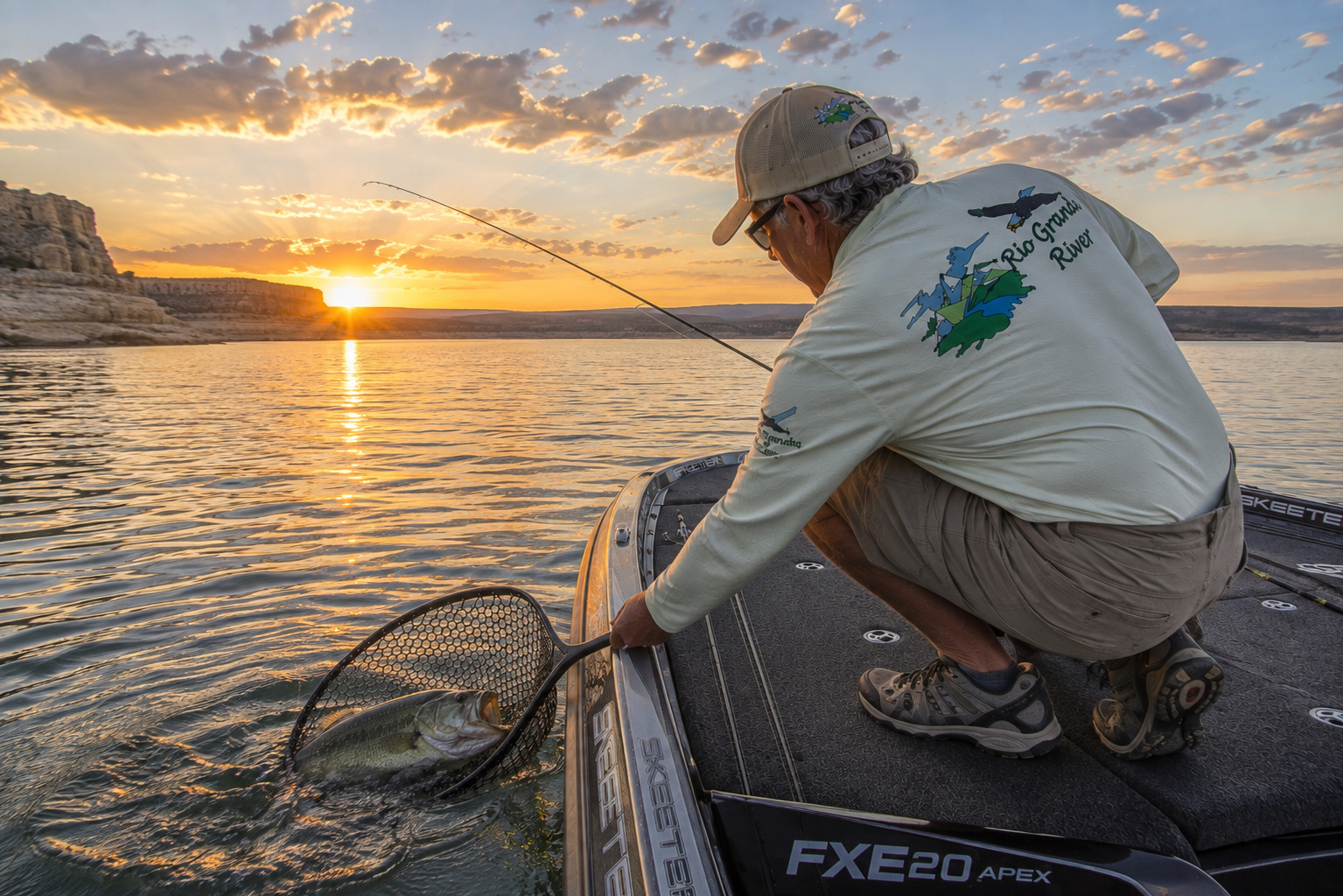
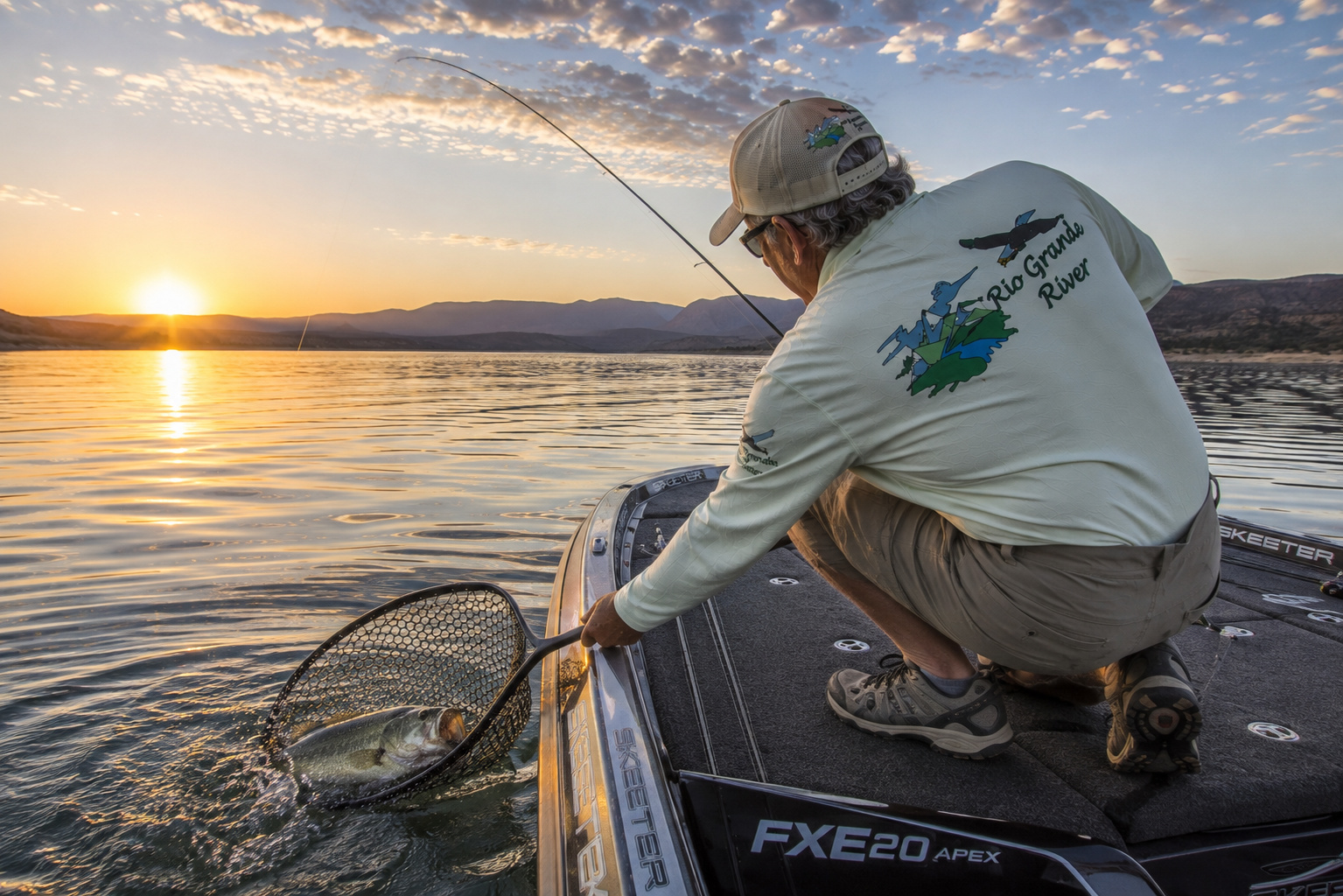
Paulette reaches for the rubber net.
A moment later the fish is lying safely in the mesh alongside the Skeeter.
Heavy.
Green.
Beautiful.
I wet my hands before touching her.
Support the belly.
One quick photograph.
Maybe Paulette tells me to smile.
Maybe I tell her I am smiling.
Then the bass goes back into Falcon.
For a second she remains beside the boat.
Her gills move.
Then her tail gives one powerful sweep.
Gone.
I sit on the edge of the front deck for a moment.
The sun has broken the horizon now.
South Texas brush is turning gold.
The Rio Grande lies somewhere beneath this enormous reservoir.
And I think about where we've been.
High above Creede, the young river ran cold enough to numb your fingers.
At South Fork, trout held beneath willow roots.
At Taos, the Rio Grande disappeared into a volcanic gorge.
At Albuquerque, cottonwoods lined the bosque.
At Elephant Butte, the river became a reservoir.
At El Paso, it became an international boundary.
At Big Bend, it carved canyons through limestone.
At Amistad, the Pecos and Devils joined it.
And now here we are.
Falcon Lake.
Largemouth bass country.
South Texas.
A river changes tremendously over nearly two thousand miles.
Maybe people do too.
I've been a Kansas ranch boy, pilot, businessman, publisher, programmer, fishing guide, tournament fisherman, mountain resident, photographer and now an old fellow fortunate enough to still be curious about what lies around the next bend.
Paulette has been beside me through most of the best parts.
Perhaps that's why I enjoy this Rio Grande project so much.
It isn't really about reaching the Gulf.
It's about everything the river shows us on the way there.
And from Falcon, we're getting close.
Downstream waits the Lower Rio Grande Valley.
The country will become greener and increasingly subtropical.
Falcon Dam will release the river again.
The Rio Grande will continue past Roma, Rio Grande City, Mission, McAllen and Brownsville.
Then, finally, after beginning as snow in the mountains of Colorado, it will meet saltwater.
But not yet.
This morning we're still on Falcon.
The sun is climbing.
There's another point ahead.
And I have a spinnerbait tied on.
Some traditions are worth keeping.
0 Comments