
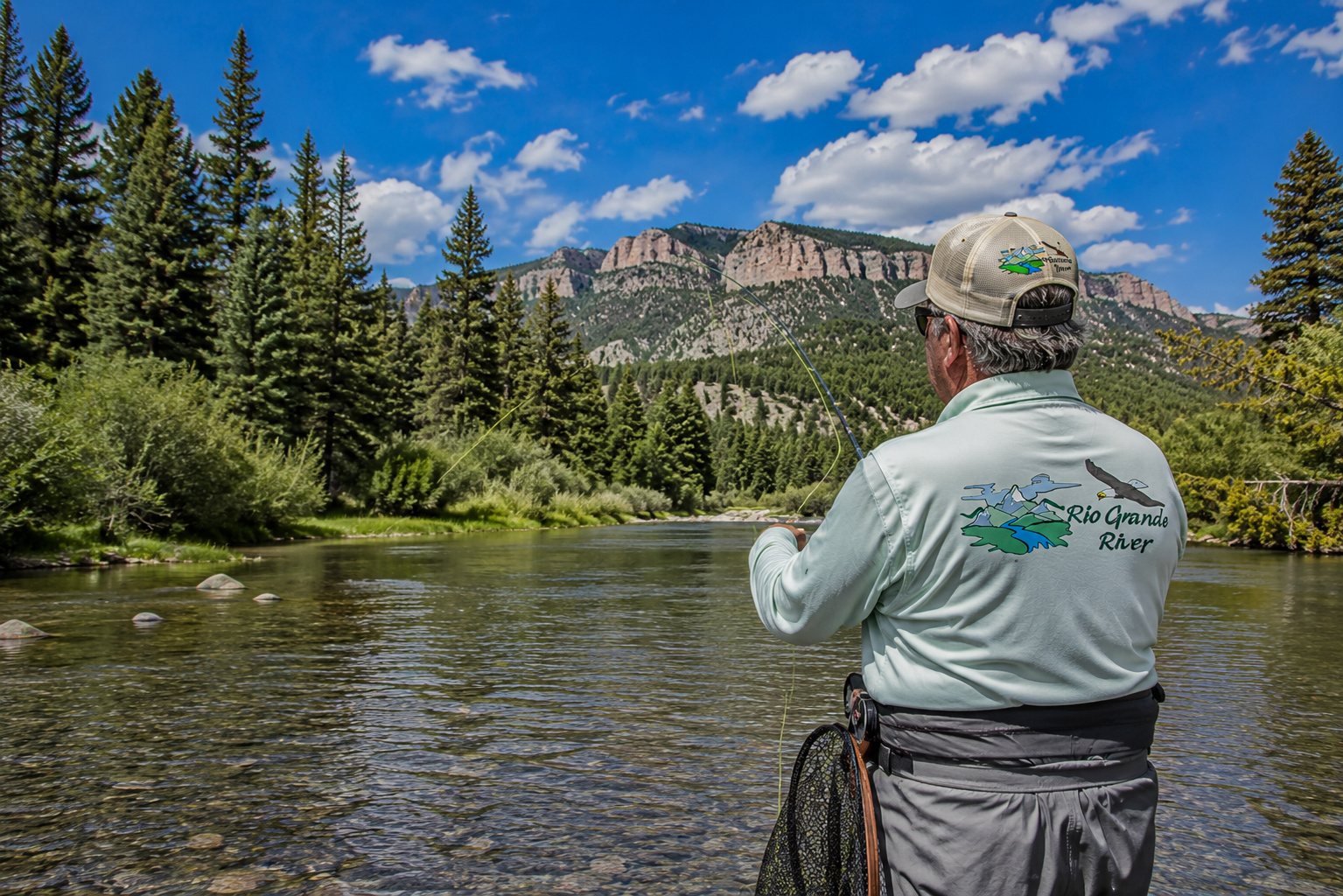
There is something about finding the beginning of a river that has always fascinated me.
Downstream, a river can become broad, powerful and complicated. It gathers tributaries, crosses highways, irrigates farms, fills reservoirs and eventually carries the history of entire communities on its shoulders.
But climb high enough into the mountains and all that grandeur disappears.
A great river becomes water tumbling over stones.
That is the Rio Grande I want to explore here.
Not the broad river crossing New Mexico. Not the desert river winding through Big Bend. Not the international boundary between Texas and Mexico.
This is the Rio Grande River at its beginning, high in Colorado's San Juan Mountains, where snowfields, springs and little mountain streams gather themselves together and begin one of the great journeys on the North American continent.
I have spent much of my life around water.
Growing up on cattle ranches in the Kansas Flint Hills taught me early that water is never merely scenery. Water determines where cattle graze, where cottonwoods grow and where wildlife gathers. A dry creek and a running creek are two entirely different worlds.
Those childhood lessons never left me.
Many decades later, Paulette and I built our mountain home in Angel Fire, New Mexico, where we spent seventeen wonderful years looking across the Moreno Valley toward Wheeler Peak, Bobcat Pass and Eagle Nest Lake. Living at 9,500 feet gives a fellow a pretty intimate acquaintance with snow, cold mornings, mountain runoff and the enormous difference a good winter can make to the country below.
Photography, videography and fishing eventually gave me additional reasons to wander through the mountains of Colorado and New Mexico.
And of all those mountain waters, the upper Rio Grande River remains one of my favorites.
This stretch, from the headwaters through Rio Grande Reservoir and downstream toward Creede, is where the river is still young.
And what a childhood it has.
Where Does the Rio Grande River Begin?
The Rio Grande rises in the rugged San Juan Mountains of southwestern Colorado.
This is high country in every sense of the phrase.
Mountains rise above timberline. Snow can linger into summer in protected places. Spruce and fir forests cover the lower slopes while willow-lined streams twist through high meadows.
The headwaters are not represented by one theatrical spring suddenly bursting from a mountainside.
Instead, the river is assembled.
Snow melts.
Springs seep from the mountains.
Tiny rivulets become creeks.
Creeks join other creeks.
Eventually those scattered mountain waters have gathered enough volume and purpose that we give them a name:
Rio Grande.
My own website's earlier account of the Rio Grande River headwaters near Creede explores this upper country and the remote cabins near Lost Trail. It is a place where a person can understand, almost instinctively, how a river is constructed from the landscape itself. (Rio Grande River)
That is an important concept when trying to understand the Rio Grande.
The river does not simply flow through these mountains.
The mountains create it.
Snow Is the River's Bank Account
Every winter the San Juan Mountains put water into storage.
Not behind concrete.
On the mountains.
Snow accumulates at high elevation through winter and early spring. When temperatures rise, that frozen reservoir gradually begins releasing its savings.
Mountain streams swell.
Tributaries strengthen.
The Rio Grande rises.
The exact timing and volume of runoff varies tremendously from year to year depending on snowpack, spring temperatures, rainfall and water-management decisions.
That is why I never assume the Rio Grande will look this summer exactly as it did last summer.
The river keeps its own calendar.
Rio Grande Reservoir: Holding Back a Young River
One of the defining features of the upper watershed is Rio Grande Reservoir, roughly twenty miles southwest of Creede.
The reservoir sits at about 9,400 feet in magnificent mountain country.
Here the young Rio Grande is temporarily gathered behind a dam before continuing downstream.
The old USGS Thirtymile Bridge gauge, located just below Rio Grande Reservoir, has a drainage area of approximately 163 square miles and sits at about 9,300 feet elevation. Historical USGS records illustrate just how dramatically flows can vary through runoff season. (Water Data)
The reservoir itself is a wonderful destination for anglers, campers, photographers and boaters.
There is a primitive boat ramp along Rio Grande Reservoir Road. Motors are allowed, although the access is not recommended for large boats or long trailers. (Recreation.gov)
Colorado Parks and Wildlife was still actively stocking Rio Grande Reservoir with catchable trout in July 2026, which tells you that this remains an actively managed recreational fishery. (Colorado Parks and Wildlife)
For a closer look at the water and fishing experience, see my earlier Rio Grande Reservoir fly fishing near Creede Colorado article.
The reservoir is worth more than a quick stop.
On a calm morning the surrounding mountains can reflect from its surface, while afternoon wind can turn that same water into something considerably less polite.
That is mountain boating in a nutshell.
The Rio Grande Below the Reservoir
Below the dam, the Rio Grande begins taking on the appearance of a serious trout river.
It leaves the reservoir, passes through rugged upper country and gradually moves toward broader valleys on its journey to Creede.
Along the way, tributaries continue adding water.
The upper watershed includes Pole Creek and numerous mountain streams, while farther downstream tributaries such as Willow Creek enter the system around Creede. The river continues gathering additional tributaries as it works toward South Fork and eventually the San Luis Valley.
Each tributary contributes more than water.
It contributes temperature.
Sediment.
Aquatic insects.
Nutrients.
Spawning habitat.
And sometimes fish.
That is why I like exploring tributaries nearly as much as the main river.
A little creek that appears insignificant from the highway may be tremendously important to the biological health of the river.
Lakes and Reservoirs of the Headwaters Country
Rio Grande Reservoir is the major impoundment directly on this upper section of the river, but the surrounding mountains are sprinkled with lakes, ponds, beaver complexes and small reservoirs.
The greater Creede area includes waters such as Love Lake, Trout Lake, Williams Lake and numerous remote high-country lakes.
Local fishing information lists brook, brown, rainbow and cutthroat trout among the fish available in various surrounding waters. Some high lakes require substantial hiking or horseback travel and can remain inaccessible surprisingly late into the year. (Creede)
That isolation is part of their charm.
There are still places in these mountains where getting to the fish requires more effort than buying a fishing license and closing the truck door.
I rather like that.
Creede Colorado: A Mountain Town at the River's Doorstep
Eventually our young river reaches the country around Creede, Colorado.
Creede sits at roughly 8,800 feet in Mineral County, surrounded by the San Juan Mountains and some of Colorado's most spectacular scenery.
It is an old mining town that has managed to keep its character.
Historic buildings and mining remnants remain part of the landscape, but today's Creede also serves fishermen, hikers, campers, hunters, photographers, Jeep travelers and families looking for a mountain vacation.
You can explore more of the community in my earlier Creede Colorado visit.
I have always preferred mountain towns that still remember what they were before tourism discovered them.
Creede qualifies.
The Rio Grande is central to the outdoor life surrounding the community.
Ancient People and the Upper Rio Grande
One thing age has taught me is that we modern travelers have a tendency to describe places as though history began when someone built a highway.
It did not.
Human beings have lived throughout the greater Rio Grande watershed for thousands of years.
Long before Creede became a mining town, long before Colorado became a state and long before anyone drew modern property lines across the mountains, Indigenous peoples moved through the greater Rio Grande region.
Water determined travel corridors.
River valleys provided plants and game.
Streams attracted elk, deer and other wildlife.
High mountain country provided seasonal hunting grounds.
Downstream, the Rio Grande became increasingly important to agricultural societies, particularly the Pueblo cultures of New Mexico.
My broader article about the ancient peoples and Rio Grande Pueblos explores that relationship farther down the watershed. (Rio Grande River)
When I stand beside the upper Rio Grande with a fly rod, I try to remember that I am only one of countless human beings who have watched this water pass.
Trout Fishing the Rio Grande River Above Creede
Now we come to the part that tends to make me forget what time it is.
Trout.
The upper Rio Grande supports an excellent cold-water fishery.
Colorado Parks and Wildlife lists brown trout and rainbow trout prominently in the upper system, with cutthroat trout also occurring in portions of the watershed. The section from the Rio Grande Fisherman Area downstream toward Marshall Park contains good habitat and large numbers of wild brown trout. (Colorado Parks and Wildlife)
Those browns are perfectly suited to this river.
They hold behind rocks.
They tuck under banks.
They settle into deeper runs.
They position along seams where fast water meets slow water and wait for the river to deliver supper.
A fisherman who learns to read those seams is halfway to catching trout.
Spinning Rods for Upper Rio Grande Trout
You do not need a fly rod to enjoy the Rio Grande.
A light spinning outfit is extremely effective where regulations permit.
For general river fishing, I like a 6- to 7-foot light-action spinning rod.
For smaller tributaries, a 5½- to 6-foot ultralight rod is wonderfully convenient.
Pair the rod with a 1000- to 2500-size spinning reel possessing a smooth drag.
Trout tackle does not need to be heavy.
In fact, heavy equipment can take much of the pleasure out of fishing these clear mountain waters.
Spinning Line
For traditional spinning tackle, 4- or 6-pound monofilament is difficult to beat.
Fluorocarbon also works well, particularly in clear water.
Another excellent arrangement is thin braided line connected to a 4- to 6-pound fluorocarbon leader.
Whatever system I use, I want a drag smooth enough to protect light line when a good brown decides he belongs in the next county.
Spinning Lures and Baits
Where bait is legal, worms and other permitted natural baits remain effective.
But regulations vary by section.
Some upper Rio Grande waters are restricted to artificial flies and lures, so never assume bait is legal merely because you used it somewhere else on the river.
My artificial lure box would include:
-
1/16- to 1/4-ounce inline spinners
-
Small spoons
-
1/32- to 1/8-ounce jigs
-
Small trout-sized soft plastics
-
Small minnow plugs
Silver and gold are old standbys.
Black, brown, olive and natural trout or baitfish patterns can be excellent in clear water.
A small spinner swung through a current seam has probably caught enough Rocky Mountain trout over the decades to populate a small country.
There is no reason to retire a technique simply because it is old.
Fly Rods and Reels
If I were allowed only one fly rod for the upper Rio Grande, I would choose a 9-foot 5-weight.
It will handle dry flies, nymph rigs and modest streamers while still allowing a good trout to demonstrate his opinion of being hooked.
For small tributaries, a 7½- to 8½-foot 3- or 4-weight can be delightful.
For heavier nymph rigs, wind or bigger water, a 6-weight has advantages.
Match the rod with a dependable reel possessing a smooth drag.
The reel does not need to resemble something from a spacecraft.
It needs to hold line, balance the rod and operate properly when a fish decides to leave.
Fly Line and Leaders
A weight-forward floating line handles most upper Rio Grande fishing.
I would carry leaders ranging roughly from 7½ to 12 feet depending upon conditions.
Clear, low water usually calls for longer leaders and finer tippet.
Higher or stained water allows heavier tackle.
For most trout situations, 4X through 6X tippet covers considerable territory.
Fluorocarbon is particularly useful for subsurface presentations.
Dry Flies for the Rio Grande
A good Rio Grande fly box does not have to contain 400 patterns.
I would rather carry proven flies in several sizes.
Useful dry patterns include:
-
Parachute Adams
-
Elk Hair Caddis
-
Blue-Winged Olive patterns
-
Stimulators
-
Griffith's Gnats
-
Pale Morning Dun patterns
-
Grasshoppers
-
Ants
-
Beetles
During summer, terrestrial insects can become especially important.
Watching a trout rise to a dry fly is still one of fishing's small miracles.
The fly drifts.
The water opens.
The trout appears.
And for one second the entire world is reduced to six feet of leader.
Nymphs for the Rio Grande
When trout are not looking up, I go downstairs.
Good nymph choices include:
-
Pheasant Tail
-
Hare's Ear
-
Prince Nymph
-
Copper John
-
Zebra Midge
-
Stonefly nymphs
-
Caddis larvae and pupae
Sizes roughly #12 through #20 cover most everyday situations, although matching local insects is always preferable.
The key is getting the fly to the trout.
A beautiful nymph drifting two feet above a fish may as well be in Denver.
Depth and drag-free presentation matter enormously.
Streamers
Do not overlook streamers for brown trout.
Woolly Buggers, small leech patterns and baitfish imitations can produce excellent fish, especially when the water has a little color or when larger browns become aggressive.
Early morning and evening are natural streamer periods.
Cloudy weather can extend that window.
Productive Water Temperatures
I consider roughly 45°F to the upper 50s prime trout water.
Trout remain active outside that range, but temperature increasingly matters as summer progresses.
Once water begins approaching the upper 60s, particularly around 68°F, I become concerned about stress.
That is when a stream thermometer belongs in the fishing vest.
If the water gets too warm, I stop.
There is no photograph or fish worth killing a trout unintentionally.
Best Time of Day to Fish
During spring, midday can be productive because the sun warms cold mountain water and stimulates insect activity.
Summer changes the equation.
I prefer early morning, particularly during warm weather.
The water has cooled overnight, trout are less stressed and the river often belongs to you before recreational traffic increases.
Late afternoon and evening can also be excellent as shadows lengthen and insects become active.
Autumn may provide wonderful fishing through a larger portion of the day.
Brown trout become increasingly interesting as fall approaches.
Barbless Hooks and Releasing Trout Properly
I strongly favor barbless hooks for trout I intend to release.
Pinching down a barb takes seconds.
Removing a barbless hook usually takes less time and causes less handling.
That matters.
I also carry a rubber landing net.
Old-fashioned knotted nylon nets can scrape protective slime and tangle fins and hooks. Rubber mesh is considerably kinder to fish.
Once a trout is in the net, I keep it fully submerged whenever possible.
Before touching it, I wet my hands.
A trout's slime coating is part of its defense against infection, and dry hands can damage that protection.
If I want a photograph, the camera is ready before the fish leaves the water.
Lift.
Photograph.
Back into the river.
Seconds, not minutes.
When a trout needs recovery time, I support it gently in clean current, facing upstream so oxygenated water passes through its gills.
I do not squeeze it.
I do not drag it backward.
And I certainly do not throw it into the river.
When the trout regains its balance and begins pulling against my hands, I loosen my grip.
Watching a healthy trout disappear beneath the current is one of the finest endings to a fishing story.
Special Fishing Regulations
Regulations vary along the river and can change.
For example, Colorado Parks and Wildlife currently identifies special regulations on portions of the upper Rio Grande, including sections where fishing is limited to artificial flies and lures, rainbow trout must be released immediately, and special brown-trout limits apply. (Colorado Parks and Wildlife)
Check the current Colorado fishing regulations before every trip.
Do not rely on an article, including this one, as a substitute for current regulations.
Public Access to the Rio Grande River
The upper river passes through a mixture of public and private property.
That makes access one of the most important things an angler needs to understand.
National Forest lands provide substantial opportunities in the upper watershed, but private ranches and other holdings occur along portions of the river.
Respect fences and posted property.
Use established access points.
Do not assume that because a highway crosses a river you have permission to wander upstream or downstream across private land.
Farther below Creede, Coller State Wildlife Area provides excellent public fishing opportunities. My earlier account of Rio Grande River public fly-fishing access at Coller State Wildlife Area provides a closer look at that water. Colorado Parks and Wildlife confirms that this area offers shore, wade and float fishing with good habitat for brown and rainbow trout. (Colorado Parks and Wildlife)
Hiking the Upper Rio Grande
Fishing is only one excuse to explore this country.
The upper watershed contains outstanding hiking through forests, meadows and wilderness.
The Lost Trail country near the headwaters is particularly memorable.
For a closer look, see my Hiking the Upper Rio Grande River account.
The farther you travel from the road, the quieter the mountains become.
At eighty-plus years old, I no longer measure a successful hike by how many miles I can put behind me.
I measure it by how often I stop.
A patch of wildflowers.
An elk track.
A trout holding beneath a bank.
Sunlight moving through aspens.
Photography has taught me that hurrying through beautiful country is an efficient way to miss most of it.
Camping Along the Upper Rio Grande River
Camping opportunities are abundant.
The Creede area lists numerous Rio Grande National Forest campgrounds, including Thirty Mile, River Hill, Rio Grande, Marshall Park, Road Canyon, Silver Thread, North Clear Creek and Palisade. (Creede)
Thirty Mile Campground is particularly convenient for the headwaters, sitting near the Rio Grande and only about a mile from Rio Grande Reservoir. (US Forest Service)
Marshall Park Campground sits directly along the river about seven miles southwest of Creede at roughly 8,800 feet. (Recreation.gov)
Remember that high-elevation nights can be cold even in July.
Bring warm clothing.
Bring rain gear.
Bring drinking water where campground supplies are unavailable.
And check current fire restrictions before building any campfire. Current restrictions can change quickly during dry Colorado summers. (Recreation.gov)
Boating and Floating
The Rio Grande Reservoir permits motorized boats, but its primitive access favors reasonably sized craft. Kayaks, canoes and small fishing boats are natural choices. (Recreation.gov)
Below the reservoir, rafting and kayaking opportunities depend heavily on flow.
The Creede area offers everything from gentle floats to substantially more technical water, with local information describing rafting and kayaking opportunities ranging into Class II-IV conditions depending upon location and flow. (Creede)
A section that looks tame in August may be a very different animal during runoff.
Cold water compounds the danger.
Wear a properly fitted personal flotation device.
Know the section before launching.
Check current flow.
And never allow a beautiful sunny morning to persuade you that mountain water is harmless.
Water Levels and River Flow
Water level may be the single most important variable when planning an upper Rio Grande fishing or floating trip.
Spring snowmelt can dramatically increase flow.
Later summer usually brings lower water.
Reservoir operations can modify the natural hydrograph.
Rainstorms can temporarily change tributaries.
The historical Thirtymile Bridge gauge demonstrates the enormous seasonal variability of this system. USGS records from earlier decades show spring runoff flows many times greater than low-water periods. (USGS Publications)
There are also monitoring locations near Marshall Park and above Creede. (Water Data)
Before traveling, I check current river conditions rather than depending on memory.
The river gets the final vote.
Wildlife of the Upper Rio Grande
This country is alive.
Elk and mule deer move through the valleys.
Moose are possible.
Black bears roam the forests.
Bighorn sheep inhabit nearby mountain terrain.
Coyotes, foxes, beaver and smaller mammals occupy the watershed.
Bald and golden eagles can be seen along the river corridor.
Marmots whistle from rocky slopes.
Waterfowl use the river and reservoir.
Trout rise beneath swallows working an evening hatch.
Sometimes the best fishing trip becomes a wildlife trip instead.
I have never considered that a disappointment.
Weather Through the Seasons
Spring
Spring arrives slowly at these elevations.
Snow may remain in the high country while lower valleys begin thawing.
Runoff generally increases as temperatures rise.
Road access into remote areas may remain limited.
Summer
Summer is the most popular recreational season.
Days can be pleasantly warm, but mountain thunderstorms can develop quickly.
Lightning at high elevation deserves respect.
Nights remain cool.
Autumn
Autumn may be my favorite.
Aspens turn gold.
Tourist traffic declines.
Morning frost becomes common.
Brown trout become increasingly active.
There is a wonderful crispness in the air.
Winter
Winter reclaims the country.
Snow accumulates.
Temperatures plunge.
Many seasonal roads and facilities become inaccessible.
The river continues beneath ice and snow, quietly waiting for another spring.
Getting to the Rio Grande Headwaters and Creede
For most travelers, Colorado Highway 149, the Silver Thread Scenic Byway, is the main doorway into Creede and the upper Rio Grande country.
From South Fork, Highway 149 follows the river northwest toward Creede.
To reach Rio Grande Reservoir, continue beyond Creede on Highway 149 and turn onto Forest Road 520, Rio Grande Reservoir Road, near mile marker 41. The route continues approximately twelve miles on gravel road toward Thirty Mile Campground and the reservoir country. (Recreation.gov)
Road conditions can vary considerably with weather and season.
A summer afternoon thunderstorm can turn a perfectly respectable mountain road into something considerably more interesting.
Check conditions before heading into remote country.
Carry water.
Carry extra clothing.
Keep fuel in the vehicle.
And let somebody know where you are going.
Those are habits I learned long ago in ranch country, and they transfer nicely to mountain travel.
Why This Part of the Rio Grande Matters
When people hear the words Rio Grande River, they often picture New Mexico, Texas or the international border.
But I think understanding the river requires seeing where it begins.
Stand beside the Rio Grande above Creede and you realize that one of North America's great rivers starts with snow.
A mountain.
A meadow.
A spring.
A creek.
Then another creek.
And another.
The water gathering at your boots will eventually travel through Colorado and New Mexico, form hundreds of miles of international boundary and make its long journey toward the sea.
That knowledge changes the way I look at a trout stream.
A Morning Beside the Young Rio Grande
If I could choose the perfect morning here, it would begin before sunrise.
There would be frost on the grass.
Coffee would be hot enough to fog my glasses.
Paulette would still be wondering why any sensible human being voluntarily leaves a warm bed at that hour.
I'd take a light fly rod, rubber net, small box of flies and camera.
The first sunlight would touch the upper mountains before reaching the valley.
Perhaps an elk would cross a meadow.
Maybe a bald eagle would work along the reservoir.
Then I would step into the river.
Cold water around my boots.
Current against my legs.
A little caddis activity along the bank.
I'd cast toward a seam behind a boulder and let the fly drift.
Maybe a brown trout would rise.
Maybe he wouldn't.
At this stage of life, I have discovered that catching the fish is only part of why I go.
The mountains are enough.
The river is enough.
The privilege of still being able to stand there with a fishing rod is certainly enough.
And if a trout does take the fly, I'll bring him gently to the rubber net.
I'll keep him submerged.
I'll wet my hands before touching him.
The barbless hook will slip free.
Perhaps I'll take one quick photograph.
Then I'll hold him gently in the cold Rio Grande until I feel strength return to his body.
When he is ready, I'll open my hands.
The trout will disappear upstream or down, whichever direction seems sensible to a trout.
And the river will keep moving.
Past Creede.
Past South Fork.
Across the San Luis Valley.
Into New Mexico.
Through country Paulette and I have loved for years.
And eventually, far beyond anything visible from that quiet Colorado morning, toward the sea.
That is the remarkable thing about the Rio Grande River.
Up here at the headwaters, it is still small enough to step across in places.
Small enough to wade.
Small enough to hear individual stones turning beneath the current.
But it already contains the beginning of an extraordinary story.
And every drop of water is headed somewhere.
0 Comments